
Citation
Marco Santucci, Ute Kolb* (2026):
Evaluation of the reproducibility and crystal tracking precision of TEM goniometers in tomography experiments.
Ultramicroscopy 282, 114308 (2026)
🔓 Open Science: Article CC BY 4.0 · code on GitHub · data on Zenodo · documentation on ReadTheDocs.
Highlights
- PyFast-ADT is fully Python-based, with minimum hardware requirements.
- PatchworkCC merges Cross-Correlation and Kalman Filter for robust crystal tracking.
- PyFast-ADT enables automated and precise tracking of nanocrystals for 3D ED.
In one sentence
A new Python-based tracking algorithm — PatchworkCC — combines cross-correlation with a Kalman filter to keep nanocrystals reliably centred during automated 3D electron diffraction acquisitions, together with the first systematic evaluation of how reproducible TEM goniometers actually are under tomography conditions.
What was done
Reliable tracking of a nanocrystal across a tilt series is one of the recurring practical bottlenecks in 3D electron diffraction. Existing tracking strategies fail when crystals drift, when contrast is weak, or when goniometer behaviour deviates from the ideal eucentric geometry. In this work, we benchmarked the reproducibility and tracking precision of TEM goniometers under realistic tomography conditions — a baseline that had so far been missing from the literature — and developed PatchworkCC, an algorithm that fuses cross-correlation matching with a Kalman filter to predict and correct crystal positions between successive tilts.
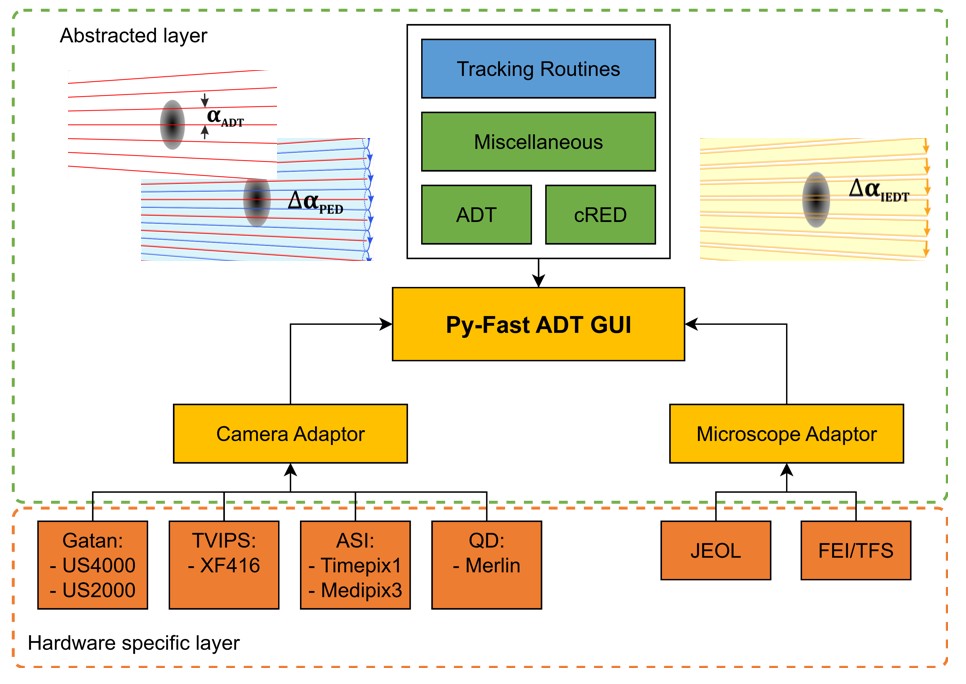
PatchworkCC is implemented entirely in Python and integrated into PyFast-ADT, our open-source acquisition framework. It runs on standard TEM hardware and requires no additional instrumentation.
Why it matters
Tracking failure is one of the most common reasons that an automated 3D electron diffraction acquisition has to be discarded — particularly on beam-sensitive, nanocrystalline, or weakly diffracting samples. By systematically quantifying goniometer behaviour, this work also gives the community a reproducibility benchmark that can be re-used for instrument comparison and method validation. PatchworkCC itself is a step toward fully unsupervised acquisitions on samples that previously required constant operator attention.
Resources
- 📄 Article (open access): Ultramicroscopy 282, 114308 (2026)
- 💻 Source code: PyFast-ADT on GitHub
- 📊 Data: Zenodo dataset (DOI: 10.5281/zenodo.17305794)
- 📖 Documentation: PyFast-ADT on ReadTheDocs
Related on this site
- Method overview: Automated Diffraction Tomography (ADT)
- Software family: ADT3D · FAST-ADT · PyFast-ADT (coming soon)
- Workflow: The eADT workflow (coming soon)
Acknowledgements
This work was supported by the European Union's Horizon 2020 ITN project NanED — Electron Nanocrystallography (grant agreement No. 956099).